United States Congress Shields Medical Cannabis Laws from Jeff Sessions’ Scrutiny

The complex interplay between federal law and state cannabis legislation in the United States has long been a charged domain, accentuated by political ambitions and social realignments. In recent years, the stance of Attorney General Jeff Sessions against cannabis — especially medical marijuana — sparked intense debate and alarm within states that had moved towards legalization. Yet, despite Sessions’ vocal opposition and his attempts to push for rigorous federal enforcement, the United States Congress has stepped in to reinforce protections for medical cannabis users and businesses. This safeguard, embodied primarily through the maintenance and renewal of the Rohrabacher-Ferr amendment, effectively restricts federal interference in state-enacted medical marijuana laws, providing a critical lifeline to millions of patients and entrepreneurs alike. The tug-of-war between Sessions’ aggressive federal oversight ambitions and Congress’ protective legislative maneuvers underscores a shifting landscape of drug policy and cannabis reform, revealing the complexities of implementing cannabis-related laws within a federal structure.
This evolving scenario has unfolded against a backdrop where public opinion heavily favors marijuana legalization, both recreationally and medically. Sessions represented a contrasting federal voice — one that saw marijuana as a dangerous drug to be eradicated. His tenure saw appeals to Congress to repeal protections that had allowed state-legal medical cannabis programs to function relatively unharmed by federal prosecution. Conversely, Congress recognized the political and social realities, understanding that opposing cannabis laws could jeopardize broader legislative support and public goodwill. Consequently, this battle encapsulates the broader tension between federal oversight and states’ autonomy in navigating cannabis policy.
As states like Colorado adjusted their regulatory frameworks — predominantly shifting toward medical cannabis industries to mitigate legal risk — the ongoing dialogue within Congress has reinforced a nuanced protective barrier. This protective legislative environment has not just preserved the burgeoning medical cannabis economy but also reassured patients and providers who depend on this treatment. With these developments into 2025, the saga of cannabis legalization amidst federal opposition offers rich insights into American legislative dynamics, drug policy evolution, and the incremental yet persistent progress of cannabis reform.
Congressional Protections Strengthening Medical Cannabis Legalization amid Jeff Sessions’ Federal Enforcement Push
United States Congress has played a pivotal role in mitigating the impact of Attorney General Jeff Sessions’ stringent efforts to reinstate federal authority over marijuana, particularly medical cannabis. Despite Sessions’ unapologetic stance to enforce Controlled Substances Act provisions against cannabis, Congress ensured that federal funds could not be used to interfere with state medical marijuana laws, primarily through the Rohrabacher-Ferr amendment. This protection has been renewed multiple times, reinforcing the political and legal buffer that preserves the medical cannabis industry from federal disruption.
Jeff Sessions, a staunch conservative and opponent of cannabis legalization, frequently voiced his belief that marijuana use should not be tolerated and labeled it as a substance that ruins lives and functions as a gateway drug. His appointment in the Trump administration sparked widespread concerns among cannabis advocates, entrepreneurs, and patients. However, the Congressional sector, reflecting shifting public attitudes, responded with protective legislative measures:
- Rejection of budget proposals to finance Department of Justice operations aimed at prosecuting state-authorized medical cannabis activities.
- Renewal of the Rohrabacher-Ferr amendment, explicitly banning the use of federal funds to interfere with medical marijuana programs.
- Bipartisan support from a broad coalition of legislators opposing Sessions’ attempts to revoke cannabis protections.
This divergence illustrates Congress’ recognition of an evolving public consensus. According to Peter DeFazio, a Democratic congressman from Oregon, while Sessions represents a significant obstacle, the Trump administration likely understands the political cost of aggressively targeting marijuana-legalizing states. Such legislative backing has given states a degree of stability and confidence as they expand medical cannabis markets and patient access.
| Protection Measure | Purpose | Impact on Medical Cannabis |
|---|---|---|
| Rohrabacher-Ferr Amendment | Prevents Federal DOJ funds from targeting medical marijuana implementers | Allows states to operate medical cannabis programs with limited federal interference |
| Congressional Budget Restrictions | Blocks funding for cannabis-related federal prosecutions | Reduces risk of federal raids and prosecutions against medical cannabis users and businesses |
| Bipartisan Legislative Support | Unites diverse political factions to protect evolving cannabis laws | Strengthens political resolve and legitimacy of state-level cannabis reforms |
For further insight into cannabis legalization trends and international developments, refer to analyses such as those presented in the overview of cannabis legalization progress or the guidelines for cannabis regulation in Alberta.
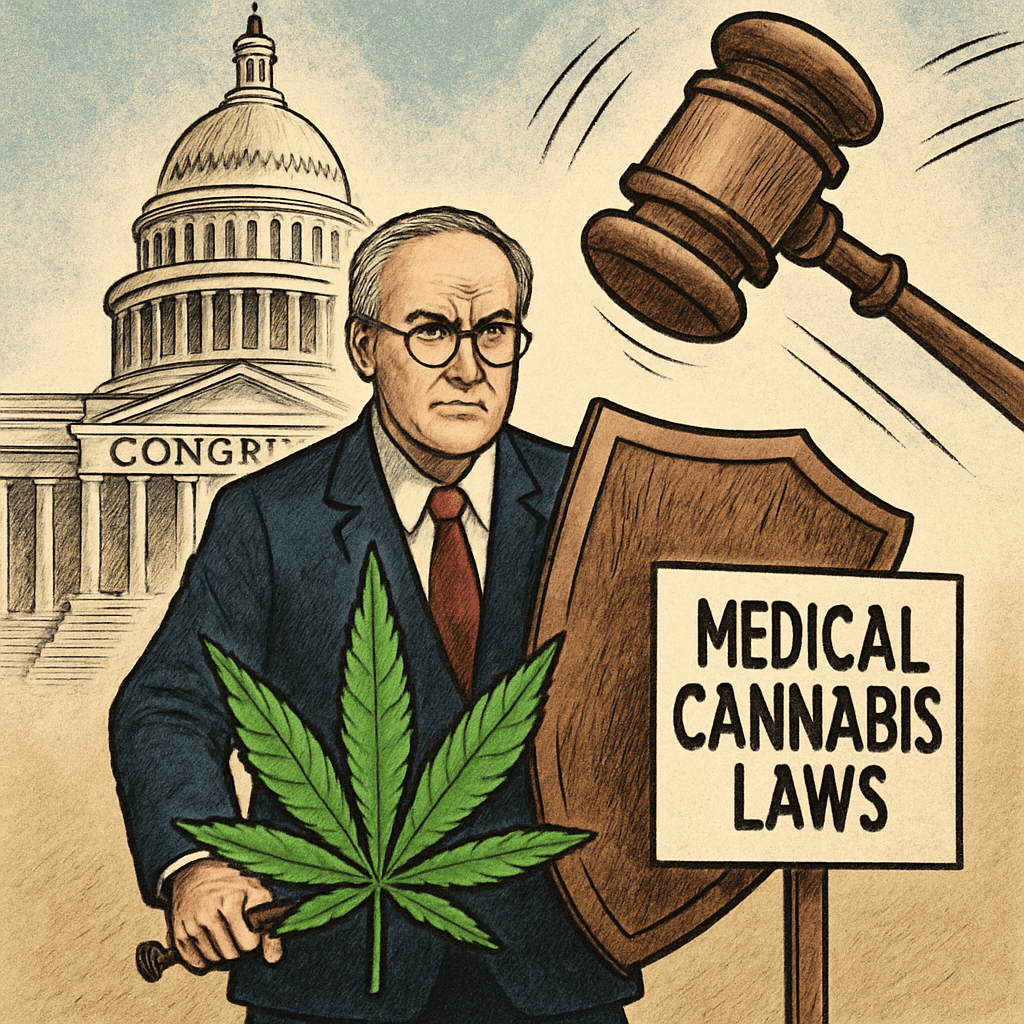
Jeff Sessions’ Opposition to Cannabis: Ideological Convictions vs. Political Realities
Jeff Sessions’ tenure as Attorney General brought to the fore a sharp ideological opposition to cannabis, rooted in his belief that it posed grave social and health risks. Sessions categorized marijuana as a destructive addiction and campaigned for strict federal enforcement against all cannabis-related activities. His rhetoric emphasized statements like “Good people don’t smoke marijuana” and warning that cannabis is a dangerous substance only “a bit less severe than heroin.”
This hardline stance manifested in specific requests to Congress to repeal medical marijuana protections and direct federal prosecutors to aggressively pursue cannabis cases, regardless of state legalization. Sessions’ approach reflected a traditional law-and-order perspective, focusing on compliance with the Controlled Substances Act (CSA), under which marijuana remains a Schedule I drug.
Yet, these intentions clashed with the prevailing political reality. Public opinion polls, including many conducted by reputable polling organizations, consistently showed a strong majority of Americans supporting medical and recreational cannabis legalization. Below are key reasons that fueled Sessions’ opposition and the contrasting forces that restrained his agenda:
- Sessions’ ideological beliefs: Deep skepticism toward drug reform, viewing cannabis as a gateway drug that fuels addiction and societal decay.
- Support from conservative groups: Law enforcement and anti-drug coalitions that endorsed tough federal enforcement.
- Growing public support: More than two-thirds of Americans backing cannabis reform, limiting political appetite for federal crackdown.
- State advocacy: States increasingly defending their sovereignty and embracing cannabis for medical benefits and economic growth.
This clash created a scenario in which Sessions appeared isolated from evolving policy currents. While his personal and political agenda aimed to reinforce federal cannabis prohibition, the wider democratic process and grassroots advocacy pushed Congress to counterbalance and restrain federal enforcement. As political commentators and medical cannabis advocates highlight, Sessions’ positions risked alienating voters in progressive states that had embraced marijuana legalization, as explained in discussions like those gathered by the debate around legalization advocates.
| Aspect | Sessions’ Stance | Political & Public Counterbalance |
|---|---|---|
| Public Opinion | Belief that marijuana use is harmful and should be discouraged | Majority support for legalization and medical use nationwide |
| Law Enforcement | Advocacy for aggressive prosecution and enforcement of federal cannabis laws | Resistance from states and lawmakers protecting cannabis industries |
| Congressional Support | Request to repeal protections such as Rohrabacher-Ferr amendment | Bipartisan backing of protections ensuring limited federal interference |
State-level Responses to Cannabis Laws Under Federal Oversight Threats
In response to Jeff Sessions’ aggressive federal approach, states with legalized cannabis programs adapted their strategies to shield their stakeholders from potential federal prosecution. States such as Colorado, which had been pioneers in cannabis legalization, showed resilience by emphasizing the medical cannabis sector — perceived as having more political and legal sustainability than recreational marijuana.
Colorado’s shift reflected a broader pattern among liberal states. Medical cannabis, with its clear therapeutic rationale and growing patient base, garners stronger bipartisan and public support. This strategy acts as a buffer, making it harder for federal enforcement agencies to justify disruption without appearing to attack patients and medical professionals.
- Expanding medical cannabis programs: States increased patient access and regulatory rigor to legitimize the industry.
- Industry normalization: Businesses structured themselves around medical products, aiming for compliance and public acceptance.
- Legislative advocacy: States worked closely with Congress to secure federal protections and alleviate operational risks.
- Public health focus: Emphasizing medical cannabis’ role in patient care diminished stigma and bolstered political support.
Further illustrating this approach, Colorado saw efforts to reduce cannabis-related hospitalizations and promote responsible use, balancing public health with industry growth, detailed in reports like those found on Colorado cannabis hospitalizations.
Challenges remain, however. Federal prohibitions persist, and the vague messaging from the Trump administration and Sessions caused uncertainty in investment and business operations. Nevertheless, state efforts to advance cannabis medicalization and regulatory refinement created a platform for progressive reforms beyond 2025.
| State Strategy | Objective | Results & Progress |
|---|---|---|
| Shift focus to medical cannabis | Reduce legal risks and align with patient needs | Increased patient registrations and stabilized industry growth |
| Advocate for federal protections | Protect businesses and consumers from DOJ enforcement | Renewal of Congressional amendments like Rohrabacher-Ferr |
| Strengthen regulatory frameworks | Ensure safety, transparency, and public health | Improved public trust and reduced adverse incidents |
The Rohrabacher-Ferr Amendment: Congressional Shield for Medical Cannabis Programs
The Rohrabacher-Ferr amendment has become a cornerstone of cannabis reform and cannabis law protection at the federal level. Passed initially in 2014 and renewed multiple times, this amendment prevents the Department of Justice from spending resources to interfere with medical marijuana programs that operate under state law. The significance of this provision cannot be overstated, as it provides a fundamental legal shield that prohibits direct federal prosecution of medical cannabis activities.
This amendment serves as an explicit Congressional rebuff to an expansive federal crackdown and preserves the autonomy of states in their cannabis legal frameworks. It accomplishes the following essential functions:
- Limits DOJ Funding: Restricts federal spending on initiatives targeting state medical marijuana laws.
- Specifies State Authority: Upholds state rights to implement medical cannabis without federal interference.
- Secures Industry Confidence: Encourages investment and growth in medical cannabis sectors by reducing federal risks.
- Supports Patient Access: Ensures continuity for patients relying on medical cannabis for treatment.
Congress’ continued dedication to renewing this amendment during the Trump presidency, despite Sessions’ objections, illustrates the political complexities around drug policy and federalism. Nonetheless, President Donald Trump’s remarks that he might disregard this amendment under his constitutional authority introduced ambiguity and unease, yet Congress remained firm in its legislative protections.
| Feature | Description | Effect on Cannabis Law |
|---|---|---|
| Prevents DOJ expenditure | Bars Department of Justice from funding prosecutions against state medical cannabis compliance | Preserves state-legal medical marijuana operations |
| Legal Clarification | Explicitly clarifies boundaries between federal and state authority on medical cannabis | Reduces federal overreach and legal uncertainty |
| Renewal Cycle | Opportunity for Congress to reevaluate and renew every fiscal cycle | Ensures ongoing protection amid shifting political environments |
For a broader global context on medical cannabis legalization and regulatory frameworks, see perspectives from other regions such as Australia’s approach to medical cannabis exports: Australia medical cannabis exports or the evolving regulations in New Zealand New Zealand medical cannabis.
Implications for Cannabis Business and Future of Drug Policy Reform in the United States
The protective actions taken by Congress amidst Jeff Sessions’ opposition have significant implications for the medical cannabis industry, patients, and the broader trajectory of drug policy reform in the United States. These protections have not only prevented immediate disruption to a burgeoning medical cannabis market but have also paved the way for an incremental normalization of cannabis legislation within the American legal system.
Businesses operating in the cannabis sector, such as Green Lion Partners, have expressed optimism that the Congressional safeguards offer reassurance to consumers and employees. Jeffrey Zucker, president of Green Lion Partners, highlighted that medical cannabis users will not need to revert to illicit markets and that companies can have greater confidence that their work remains lawful under state protections.
Key implications and potential future developments include:
- Stability in Business Operations: Reduced federal raids and prosecutions create a more predictable legal environment for cannabis companies.
- Increased Investment: Investor confidence grows as legal risks decline, encouraging further expansion and innovation.
- Policy Momentum: Legislative protections feed into broader cannabis reform efforts, including prospective recreational legalization in more states.
- Patient Access Security: Patients who rely on cannabis for treatment gain continued access without fear of federal intervention.
The ongoing tension between federal legislation and state-level cannabis laws continues to evolve. Discussions on cannabis-related policies remain heated, but the trajectory suggests growing Congressional protection against aggressive federal enforcement efforts. This dichotomy emphasizes the importance of continued advocacy and legislative action to safeguard medical cannabis frameworks as part of comprehensive drug policy reform.
| Impact Area | Current Status | Future Prospects |
|---|---|---|
| Business Environment | Protected by Congressional appropriations and amendments | Likely expansion with improved federal-state relations |
| Patient Rights | Secured under protective amendments like Rohrabacher-Ferr | Expanded access and medical research opportunities |
| Drug Policy Reform | Slow adjustment amid federal-state tensions | Potential for comprehensive cannabis legislation federal-wide |
For further reading on cannabis industry regulation and cultural evolution, explore topics such as the Cannalex cannabis regulation or the cultural phenomenon outlined in dabbing cannabis culture.


Post Comment