Initial Insights on Cannabis Legalization in Canada

The legalization of cannabis in Canada has marked a monumental shift not only in the country’s legal landscape but also in public health, economic policy, and law enforcement strategies. Since the Cannabis Act came into effect in October 2018, Canada has witnessed numerous regulatory experiments and adjustments, progressing toward a complex but potentially effective framework aimed at balancing consumer access with public safety. As of 2025, new insights and leaked data suggest that the nation is preparing to refine its cannabis policies further, motivated predominantly by the imperative to dismantle a thriving black market valued at approximately 7 billion dollars annually.
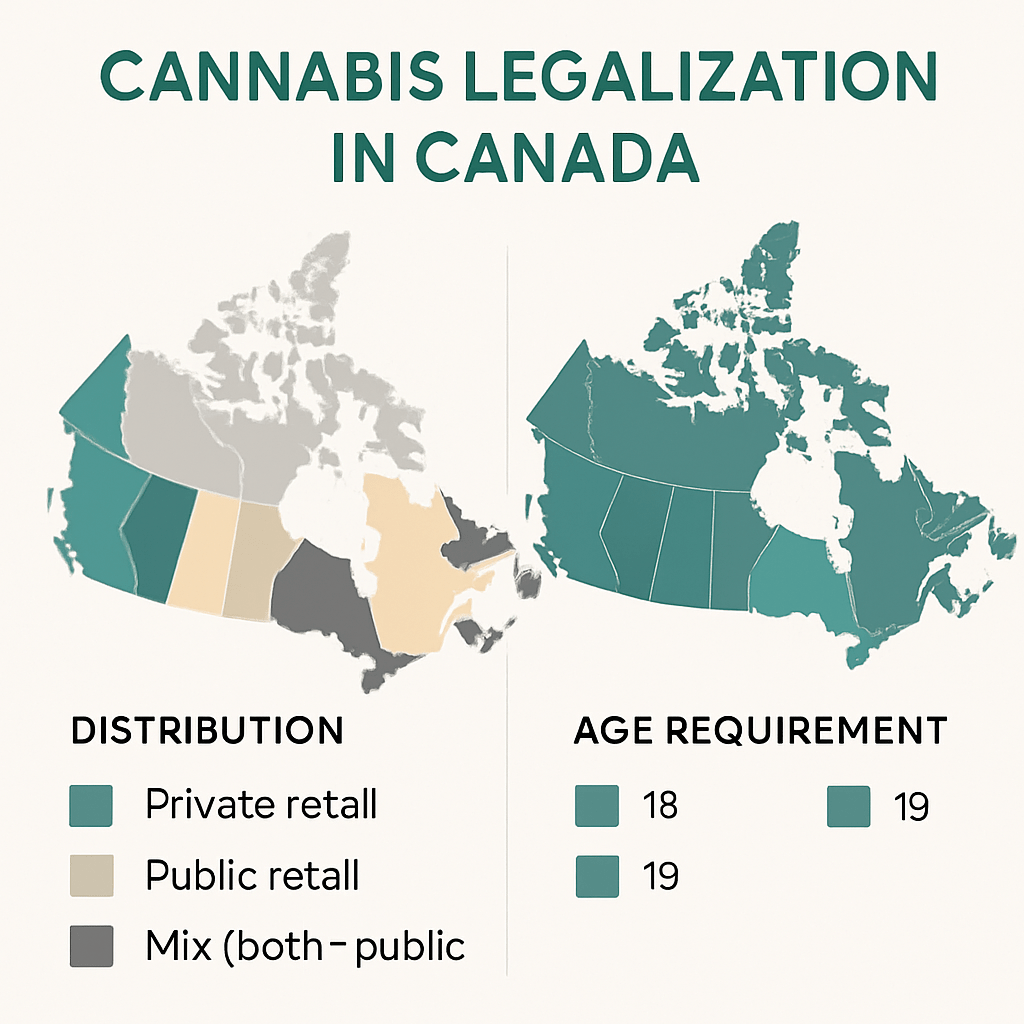
This ongoing battle against illicit cannabis distribution emphasizes the need for coordinated provincial regulations, particularly with regard to age restrictions and pricing strategies. While some provinces have mandated the legal consumption age at 19, others have chosen 18, and the Canadian Medical Association has recommended an age of 21 with additional controls on potency and purchase limits. These differing standards underscore a crucial tension between federal ambitions and provincial autonomy, a dynamic that continues to influence policy discourse.
Price regulation, in particular, stands out as a cornerstone for curbing black market sales. Current street prices fluctuate between $8 and $10 per gram, which the government aims to undercut with lower legal retail prices, even at the expense of reduced tax revenues. This strategy prioritizes public health and controlled access to safe cannabis products. Maintaining robust supply chain transparency, especially through systems tracking every stage from seed to consumer, remains a key regulatory feature to reassure public and institutional confidence.
The future legislation, expected to be unveiled officially by the end of December, also addresses the evolving role of distribution channels. Existing online mail-order systems are anticipated to remain central, complemented by provincial initiatives such as Ontario’s proposal to integrate cannabis sales through its extensive network of liquor stores. Additionally, licensed dispensaries, particularly in regions like British Columbia, are poised to continue their operations under stringent licensing and sourcing requirements.
On the production front, the 36 currently licensed producers retain their permits, while the market opens up for new entrants seeking licenses. Producer advocacy for brand development and marketing is gaining traction, reflecting a maturing cannabis industry aiming for market differentiation and consumer engagement. As Canada navigates these complexities, the coming months look promising for both regulatory innovation and economic growth within the cannabis sector.
Provincial Cannabis Regulations: Navigating Legal Age and Distribution Policies
Canada’s unique federal structure delegates significant authority to provinces in regulating cannabis within their jurisdictions. These regional variations manifest most conspicuously in the legal age for cannabis consumption and the modalities of distribution. As the government targets dismantling the entrenched illicit market, provincial policies play a critical role in shaping consumer behaviors and market dynamics.
Currently, six provinces have adopted 18 as the minimum legal age for cannabis purchase and consumption, while others such as British Columbia, Newfoundland and Labrador, and New Brunswick, along with three territories, have set this age at 19. This divergence intends to restrict youth access while respecting regional norms and concerns. Conversely, the Canadian Medical Association advocates for an age threshold of 21, coupled with restrictions on the potency and quantity of cannabis an individual may possess, reflecting greater caution based on medical perspectives.
Distribution mechanisms in provinces also reveal contrasting strategies. A key federally supported distribution channel has been the mail-order system, leveraging an efficient track-and-trace supply chain ensuring products are verified by Health Canada. However, provinces customize retail options to suit local contexts:
- Ontario is exploring the integration of cannabis sale points within its approximately 600 liquor stores, seeking to leverage existing retail infrastructure.
- British Columbia permits licensed dispensaries to continue operations, provided they source cannabis from federally authorized producers.
- Alberta regulates private retail outlets, emphasizing market competition and accessibility.
- Quebec maintains a government-run monopoly on cannabis retail through the Société québécoise du cannabis (SQDC).
These examples illustrate the balancing act provinces perform between maintaining control and stimulating a legitimate cannabis market. Setting the legal age influences both public health outcomes and enforcement priorities, while distribution models impact consumer convenience and the extent to which legal outlets can supplant the black market.
| Province / Territory | Legal Age | Primary Distribution Model | Remarks |
|---|---|---|---|
| Ontario | 19 | Government-operated & retail integration with liquor stores | Plans to expand retail into existing liquor outlets |
| British Columbia | 19 | Licensed dispensaries + mail delivery | Private dispensaries must source from licensed producers |
| Alberta | 18 | Private retail stores | Encourages market competition |
| Quebec | 18 | Government monopoly (SQDC) | Exclusive government retailer |
Managing these provincial differences is essential to crafting a cohesive national policy that ultimately curtails illegal activity and promotes safe cannabis consumption practices. For further reading on evolving legislation and comparative international regulation strategies, policymakers and stakeholders often consult resources including French cannabis legalization initiatives and the growing trends documented by European cannabis legalization efforts.
Price Regulation and Economic Impact on Canada’s Cannabis Market
One of the pivotal factors influencing the success of cannabis legalization lies in the economic realm, specifically in pricing strategies that entice consumers toward legal channels rather than illicit markets. In Canada, the street price for cannabis ranges from $8 to $10 per gram. Governments face the challenging decision of setting legal retail prices competitively low enough to discourage black market purchases while still generating sufficient tax revenue and supporting licensed producers.
The anticipated policy recommendations suggest a deliberate approach to keep retail prices just below illicit market levels. This move, while potentially diminishing immediate tax income, is intended to maximize long-term public health benefits, ensure product safety, and capture a broader consumer base into a regulated environment. The economic calculus extends beyond pricing:
- Tax structure: Balancing excise taxes and sales taxes to avoid excessive cost inflation.
- Market competition: Encouraging new producers to innovate and offer diverse product lines.
- Branding and marketing: Facilitating producer branding to enhance consumer trust and product distinction.
- Supply chain transparency: Reducing costs through efficient distribution while ensuring safety and compliance.
These considerations collectively shape the industry’s robustness and consumer behavior. For instance, a prominent licensed producer in Ontario observed that well-established brands with distinctive packaging and clear quality assurances have gained significant market shares, even in the face of lower street prices.
| Factor | Impact on Market | Policy Considerations |
|---|---|---|
| Lower retail prices | Reduces black market attractiveness | Possible tax revenue reduction |
| Excise & sales taxes | Influences consumer purchase decisions | Need to balance revenue and prices |
| Branding allowance | Enhances consumer trust and differentiation | Marketing regulation must prevent misleading claims |
Additionally, the economic impact of cannabis legalization resonates beyond direct sales. It influences employment opportunities within licensed production and retail sectors, tax income estimations for provincial budgets, and investment in research around public health and law enforcement adaptation. Comparisons to other regions, including U.S. states with legalized cannabis and European countries experimenting with semi-legal markets—such as Berlin’s recent developments (Berlin semi-legalization)—offer valuable lessons for Canadian policy refinement.
Public Health and Safety Considerations in Cannabis Legalization Policies
Canada has framed cannabis legalization not merely as a matter of personal freedom but fundamentally as a public health strategy. This approach guides policy decisions aimed at reducing harm, protecting vulnerable populations, and ensuring responsible use. The integration of health expertise into cannabis regulation is critical for signaling the government’s commitment to safe consumption environments and long-term societal wellbeing.
Key public health priorities include:
- Age restrictions: Preventing early access to reduce risks of dependency and cognitive impacts on developing brains.
- Product potency limits: Restricting THC levels in consumer products to mitigate potential adverse effects.
- Consumer education: Promoting awareness of safe usage practices and risks associated with overconsumption.
- Accessibility of approved products: Ensuring consumers can easily access regulated, tested cannabis rather than resorting to unsafe black market alternatives.
The leaked report indicates plans to maintain the existing mail-order distribution system not only for convenience but because it allows precise product tracking and quality assurance, vital for public safety. Provincial governments maintain latitude to legislate according to local needs but within the framework provided by federal oversight. Such collaborative governance aims to strengthen law enforcement’s efficacy by narrowing illicit market opportunities and focusing resources on genuine public safety threats.
| Public Health Measure | Objective | Expected Outcome |
|---|---|---|
| Legal age limits (18-21) | Delay initiation of cannabis use | Reduce youth exposure and long-term harms |
| Potency caps | Limit THC concentration in products | Minimize overdose and dependency risks |
| Product tracking and testing | Ensure safety and lawful sourcing | Increase consumer confidence and reduce black market |
International perspectives, such as in Germany’s ongoing cannabis policy discussions (Germany’s collaboration), and experiences from North American states also inform Canada’s evolving framework. Understanding these multi-dimensional challenges is essential for harmonizing policy with public health imperatives.
Law Enforcement and the Challenge of Curbing the Black Market
Law enforcement agencies in Canada have faced significant challenges in eradicating the black market while respecting individual rights and maintaining effective regulatory oversight. The illicit market’s valuation, estimated at 7 billion dollars annually, underlines the scale of the issue and demands innovative policing and regulatory collaboration.
The legalization framework aims to weaken illegal operations by making legal cannabis more accessible, affordable, and verifiably safe. Key law enforcement strategies include:
- Strict licensing for producers and retailers to close gaps exploited by illicit actors.
- Robust product tracking systems ensuring full transparency from seed to sale.
- Targeted enforcement against unlicensed dealers and counterfeit product networks.
- Public reporting mechanisms fostering community involvement in identifying illegal cannabis activity.
Provincial variations in retail models have necessitated collaborative approaches between local police and regulatory bodies to share intelligence and coordinate responses. For example, British Columbia’s continuation of licensed dispensaries as opposed to outright closures reflects a pragmatic approach to transition illicit operators into the legal market through compliance incentives. This method strives to reduce disruptions caused by sudden enforcement actions and promotes sustainable law enforcement outcomes.
| Law Enforcement Strategy | Purpose | Effectiveness |
|---|---|---|
| Strict licensing regimes | Prevent piracy in cannabis sales | Enhances market integrity |
| Seed-to-sale tracking | Ensure product legitimacy | Reduces counterfeit and theft |
| Focused enforcement against unlicensed sellers | Disrupt black market networks | Limited by resource constraints but impactful |
Monitoring global cannabis policy developments, as detailed by various reports including those outlining legislative changes in places like South Dakota (South Dakota’s challenges), provides valuable lessons to refine enforcement policies. Integrating community input and adapting to market evolution remain key to diminishing the illegal cannabis economy effectively.
Canada’s Cannabis Industry Future: Production, Branding, and Market Expansion
Looking ahead, the cannabis industry in Canada is positioned for substantial growth and transformation. The forthcoming legislation expected in late 2024 and early 2025 aims to open opportunities for new licensed producers while maintaining stability for the 36 existing facilities. This sustained growth trajectory reflects both domestic demand and increasing interest in international cannabis markets.
A notable shift in policy is the encouragement of brand development and marketing within regulated boundaries. Producers argue that strong, identifiable brands are crucial for capturing consumer loyalty and enabling product differentiation—an approach common in other mature industries. By empowering producers with branding rights, the market may evolve from commoditized bulk sales to more sophisticated consumer offerings such as:
- Craft cannabis products targeting niche consumer preferences.
- Innovative cannabis-infused consumables with clear labeling and efficacy claims.
- Environmentally sustainable production practices marketed to eco-conscious consumers.
Moreover, provincial governments remain active players in shaping retail landscapes. Ontario’s contemplated integration of cannabis sales within liquor stores exemplifies attempts to leverage existing retail infrastructure to maximize accessibility and convenience. Meanwhile, provisions allowing licensed dispensaries to operate under strict sourcing obligations promise greater market fluidity.
| Industry Aspect | Current Status | Future Direction |
|---|---|---|
| Licensed producers | 36 current licenses | Open to new entrants; industry growth expected |
| Branding and marketing | Highly restricted initially | Encouraged with regulations to prevent misleading advertising |
| Retail distribution | Fragmented by provincial models | Potential consolidation and innovation (e.g., liquor stores sales) |
Overall, Canada’s cannabis industry is transitioning from a nascent phase toward becoming a mature, economically significant sector. The evolving legal framework attempts to foster a balanced market encouraging innovation, consumer safety, and competitive pricing. Observers and stakeholders closely watch legislative developments and international contexts, such as the Pennsylvania cannabis legislative reforms aligned with neighboring states (Pennsylvania reforms), for comparative insights.


Post Comment